
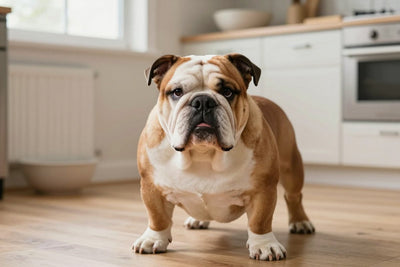
A fawn-and-white Bulldog sitting on the cool floor of a bright kitchen
Breed Encyclopedia

Bulldog

The Bulldog is a calm, kind and friendly English breed with a low-slung body and a big, wrinkled head. Short walks keep a Bulldog happy, but its flat face and deep folds mean it overheats easily and needs a little extra everyday care.
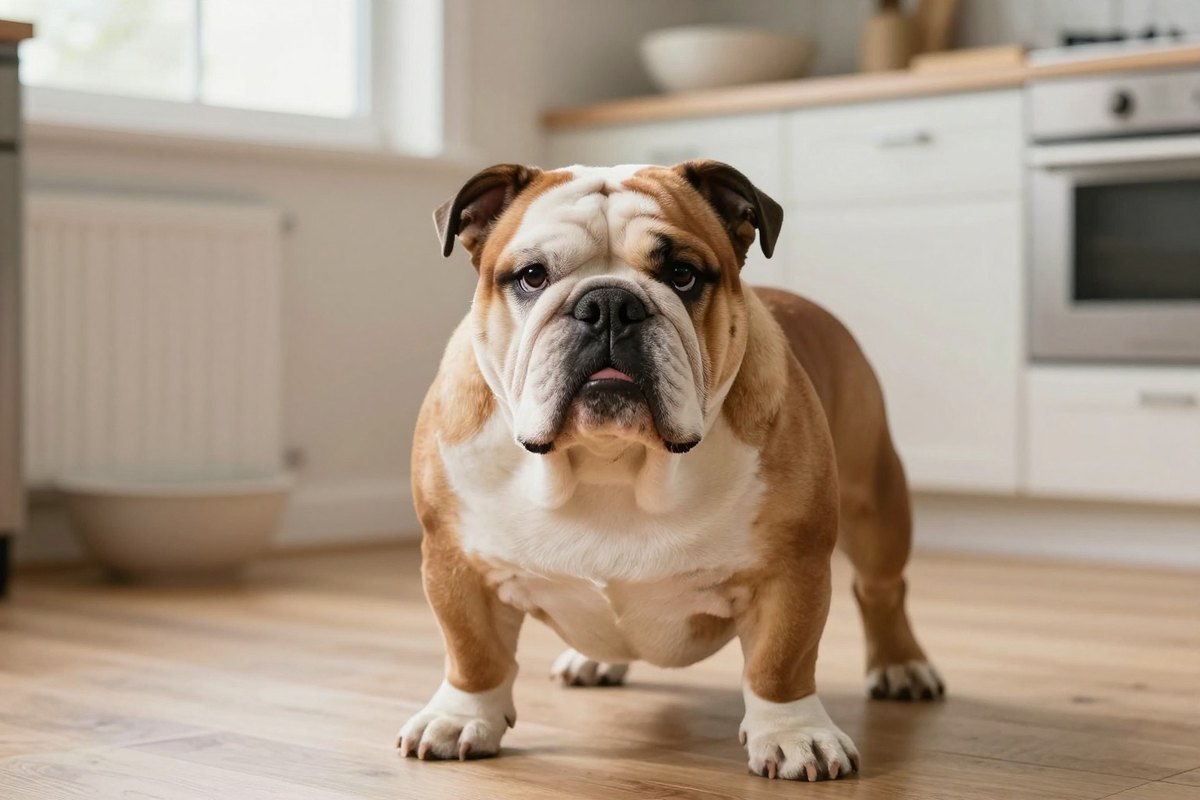
A fawn-and-white Bulldog sitting on the cool floor of a bright kitchen

  • SizeMedium
  • AKC groupNon-Sporting Group
  • Height14-15 in
  • WeightMales about 50 lb, females about 40 lb
  • Life expectancy8-10 years
Part A

About the Bulldog

Origin and purpose

The Bulldog comes from England, where it was bred for bull-baiting, a blood sport Parliament outlawed in 1835. Breeders then selected for a gentle, non-aggressive temperament, and the breed carried on as a companion. (AKC fun facts, Bulldog Club of America)

Coat and energy

The coat is short, straight, flat, fine and glossy, lying over loose skin with heavy wrinkles on the face. Standard colors are red, white, fawn, fallow or mixes of these, and brindle and piebald patterns are allowed. (AKC breed standard, AKC)

Energy is low. AKC calls Bulldogs laid-back and says short walks are ideal, and the breed club suggests moderate daily leash walks except in very warm weather. (AKC, Bulldog Club of America)

Nutrition and weight

The breed club suggests feeding puppies under six months three times a day and adults twice a day on a regular adult diet, and it does not recommend the high-protein diets often fed to hunting and herding breeds. It blames obesity on overeating plus too little exercise. (Bulldog Club of America)

Staying trim helps a Bulldog breathe and cope with heat. University of Cambridge airway researchers tell owners of flat-faced breeds to keep their dogs fit and not let them get fat, and in UK veterinary records dogs at or above their breed-and-sex average weight had higher odds of heat-related illness. (University of Cambridge, Hall et al. 2020)

Real-life Bulldogs often weigh more than AKC's 40-50 lb: UK primary-care records showed a median adult weight of 25.55 kg (about 56 lb). Ask your veterinarian what a healthy weight and shape look like for your own dog, and keep all treats under 10% of daily calories, a widely used Tufts guideline. (VetCompass, AKC, Tufts)

Health watch

AKC lists a life expectancy of 8-10 years. (AKC breed page)

  • Brachycephalic obstructive airway syndrome (BOAS): Breathing trouble caused by the very short face, such as narrow nostrils and a crowded airway; in UK primary-care records English Bulldogs had about 19 times the odds of other dogs of being diagnosed with it. In a study of 73 flat-faced dogs with the syndrome (13 of them English Bulldogs), 74% had moderate to severe digestive signs such as regurgitation and vomiting, so small, soft, easy-to-swallow treats and a lean body make sense. (VetCompass, Poncet et al. 2005, University of Cambridge)
  • Skin fold dermatitis: Irritation or infection in the deep folds of the face (the breed club also flags tight screw tails); UK records showed English Bulldogs had about 38 times the odds of other dogs. AKC notes that moisture and food trapped in the wrinkles can cause irritation and infection, so wipe the face after sticky or crumbly treats and keep the folds dry. (VetCompass, AKC, Bulldog Club of America)
  • Eye problems: cherry eye, dry eye and entropion: In UK records English Bulldogs had about 27 times the odds of cherry eye (the third-eyelid tear gland slipping out as a red lump) and about 12 times the odds of both dry eye (keratoconjunctivitis sicca) and entropion (eyelids rolling inward). No specific treat link. (VetCompass)
  • Urinary stones (cystine and urate): Mineral stones in the urinary tract; the Merck Veterinary Manual names English Bulldogs among breeds affected by cystinuria (cystine stones) and links a urate-transporter gene (SLC2A9) mutation to urate stones in some English Bulldogs. Diet is part of veterinary management for both kinds of stone, so if your Bulldog has had stones, ask your veterinarian before adding any homemade treats. (Merck: urinary stones)
  • Heat-related illness (heatstroke): Dangerous overheating; in UK primary-care records Bulldogs had significantly higher odds than Labradors, and flat-faced dogs overall had about twice the odds of medium-muzzled dogs. Dogs at or above their breed's average weight also had higher odds, so a lean Bulldog is better off, and treats should never be used to coax play in hot weather. (Hall et al. 2020, Bulldog Club of America, AKC)

Fun fact

More than 40 U.S. universities, Georgetown and Yale among them, have a Bulldog as their mascot. (AKC fun facts)

Part B

Baking, treats and ingredients

Breed-specific baking notes

  • Cut treats small, soft and easy to swallow. Flat-faced dogs with airway syndrome commonly regurgitate or vomit, and English Bulldogs were part of the study that showed it. (Poncet et al. 2005)
  • Wipe the face after sticky glazes or crumbly cookies. AKC warns that food trapped in a Bulldog's wrinkles can lead to irritation and infection. (AKC)
  • Portion for a 40-50 lb dog with low exercise needs. Keep all treats under about 10% of daily calories; the breed club links obesity to overeating plus too little exercise. (AKC, Tufts, Bulldog Club of America)
  • Skip treat-fueled games on hot days. Bulldogs overheat easily, the breed club strongly recommends air conditioning, and UK data show Bulldogs at higher risk of heatstroke. (Bulldog Club of America, Hall et al. 2020)

General baking safety (all dogs)

  • Leave these out of every bake. Chocolate and cocoa (baking chocolate and cocoa powder are the most concentrated), coffee, espresso powder, caffeinated tea or anything else with caffeine, grapes and raisins, macadamia nuts, and onion, garlic or chives. If your dog eats any of these, contact your veterinarian or an animal poison control line, such as the ASPCA Animal Poison Control Center at (888) 426-4435, right away. (ASPCA)
  • Be honest about vanilla. Under the U.S. standard of identity, vanilla extract must contain at least 35% alcohol by volume, and the ASPCA lists alcohol as dangerous for pets. Leave alcohol-based extracts, vanilla included, out of dog treats, and check the label of any other flavoring for alcohol. (21 CFR 169.175, ASPCA)
  • Never use xylitol. The FDA warns it can crash a dog's blood sugar within 10 to 60 minutes and that it can turn up in sugar-free gum and candy, some peanut and nut butters, baked goods and sugar-free desserts, so read the label of every ingredient. If your dog eats xylitol, contact your veterinarian or an animal poison control line right away. (FDA)
  • Bake yeast dough all the way through. Keep raw dough out of reach: the ASPCA says raw yeast dough can expand in the stomach and makes alcohol as it ferments. (ASPCA)
  • Keep fat, salt and dairy modest. The ASPCA says fatty nuts such as almonds, pecans and walnuts can cause vomiting, diarrhea and possibly pancreatitis, that too much salt is harmful, and that many pets digest milk and dairy poorly. (ASPCA)

Daily calories and treat budget

A typical neutered adult at 40-50 lb needs roughly 985-1,164 kcal a day (RER x 1.6, Merck Veterinary Manual), so treats should stay under about 98-116 kcal a day (the 10% guideline). Intact, very active, young, senior or overweight dogs differ, so ask your veterinarian for your dog's number.

Check an ingredient before you bake, and see how to portion treats with the 10% rule.

Treat size: For a typical neutered adult Bulldog at 40-50 lb, keep treats under about 98-116 kcal a day, roughly 10% of daily calories.

Ask your veterinarian about

  • Brachycephalic obstructive airway syndrome (BOAS)
  • Skin fold dermatitis
  • Cherry eye, dry eye and entropion
  • Urinary stones (cystine and urate)
  • Heatstroke

Breed tendencies don't mean your dog has a condition. Your veterinarian knows your dog.

Ingredients to know

Sources

  1. Bulldog Facts You May Not Know, American Kennel Club. Checked October 22, 2026.
  2. A Bulldog!, Bulldog Club of America (AKC parent breed club), flier hosted by AKC. Checked October 22, 2026.
  3. Official Standard for the Bulldog, American Kennel Club. Checked October 22, 2026.
  4. Is the Bulldog a Good Fit for You?, American Kennel Club. Checked October 22, 2026.
  5. No simple way of predicting breathing difficulties in pugs, French bulldogs and bulldogs from external features, University of Cambridge. Checked October 22, 2026.
  6. Incidence and risk factors for heat-related illness (heatstroke) in UK dogs under primary veterinary care in 2016, Scientific Reports (Hall EJ, Carter AJ, O'Neill DG, 2020). Checked October 22, 2026.
  7. English Bulldogs in the UK: a VetCompass study of their disorder predispositions and protections, Canine Medicine and Genetics (VetCompass, Royal Veterinary College; 2022). Checked October 22, 2026.
  8. Growth Guide: Keeping your Puppy on the Right Track, Tufts University Cummings School of Veterinary Medicine (Petfoodology). Checked October 22, 2026.
  9. Prevalence of gastrointestinal tract lesions in 73 brachycephalic dogs with upper respiratory syndrome, Journal of Small Animal Practice (Poncet et al., 2005); copy hosted on a Cornell University server. Checked October 22, 2026.
  10. Urolithiasis in Dogs, Merck Veterinary Manual. Checked October 22, 2026.
  11. People Foods to Avoid Feeding Your Pets, ASPCA Animal Poison Control Center. Checked October 22, 2026.
  12. 21 CFR 169.175 -- Vanilla extract., U.S. Food and Drug Administration regulation, published in the Electronic Code of Federal Regulations (eCFR). Checked October 22, 2026.
  13. Paws Off Xylitol; It's Dangerous for Dogs, U.S. Food and Drug Administration. Checked October 22, 2026.
  14. Breed page (height, weight, life expectancy), American Kennel Club. Checked October 22, 2026.

Last checked against these sources: October 22, 2026.

Written by VanillaGoods from the cited sources. Not reviewed by a veterinarian. Not a substitute for veterinary advice.