
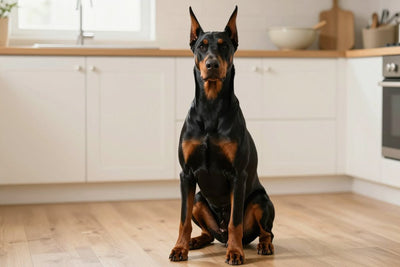
A black-and-rust Doberman Pinscher sitting tall in a bright kitchen
Breed Encyclopedia

Doberman Pinscher

The Doberman is a sleek, powerful and very smart working dog, first developed in Germany as a personal protection dog. Well trained and socialized, Dobies are affectionate, playful family companions that need plenty of daily exercise and mental work, plus a close eye on heart health.

A black-and-rust Doberman Pinscher sitting tall in a bright kitchen

  • SizeLarge
  • AKC groupWorking Group
  • HeightMales 26-28 in, females 24-26 in
  • WeightMales 75-100 lb, females 60-90 lb
  • Life expectancy10-12 years
Part A

About the Doberman Pinscher

Origin and purpose

The breed comes from Apolda, in Thuringia, Germany, in the late 1800s. Karl Friedrich Louis Dobermann, a tax collector, developed it as a protection dog to travel with him, and the breed went on to police and military work and to life as a home guardian and companion. (DPCA history, AKC Working Group, AKC fun facts)

Coat and energy

The coat is short, smooth, hard and thick, lying close to the body, and an invisible gray undercoat on the neck is allowed. Colors are black, red, blue and fawn (Isabella), with rust markings, and grooming is low-maintenance. (AKC breed standard, AKC)

AKC calls the Doberman a high-to-medium energy breed that needs daily physical and mental activity, and its breed facts say Dobies need a great deal of exercise every day. (AKC, AKC fun facts)

Nutrition and weight

Doberman puppies are large-breed puppies. Merck advises a diet labeled for growth of large-size dogs (those expected to reach 32 kg, about 70 lb, or more as adults) and says slow growth is better than fast growth, and Tufts veterinary nutritionists add that extra calories speed growth and can raise the risk of lifelong bone and joint problems. (AKC, Merck: feeding, Tufts)

Merck also says adding calcium on top of a complete and balanced growth diet is rarely necessary and may be harmful, so puppy treats should never be used to add supplements. (Merck: feeding)

Merck lists the Doberman among breeds predisposed to an underactive thyroid, and weight gain without a bigger appetite is a classic sign. If your Doberman gains weight on its usual food and treats, have your veterinarian check it rather than only cutting treats, and keep all treats under 10% of daily calories. (Merck: thyroid, Merck: feeding, Tufts)

Health watch

  • Dilated cardiomyopathy (DCM): The heart muscle weakens and the heart enlarges, so it pumps poorly. Merck names Dobermans among the large breeds most at risk, notes that some carry a gene mutation linked to it, and says collapse or sudden death occurs in as many as 20% of affected Dobermans. The breed club recommends heart screening with an echocardiogram and a 24-hour Holter monitor. No specific treat link; if your dog is diagnosed, ask your veterinarian which treats fit its care plan. (Merck: heart, DPCA health)
  • von Willebrand disease: An inherited bleeding disorder caused by a missing or faulty clotting protein (von Willebrand factor), which can lead to abnormal bleeding such as nosebleeds or bleeding gums. Merck names the Doberman among breeds where it is most common, and the breed club says carriers are quite common in the breed; a DNA test is available. No specific treat link. (Merck: bleeding, DPCA health)
  • Wobbler syndrome (cervical spondylomyelopathy): The spinal cord in the neck gets squeezed, causing a wobbly, unsteady walk. Merck says the disc-related form affects middle-aged large-breed dogs, especially Dobermans, with a typical onset around 7 years. Merck counts weight loss, when needed, in the care of mild cases, so keeping a Doberman lean, with treat calories counted, is sensible. (Merck: spine, DPCA health)
  • Copper-associated liver disease: Copper builds up in the liver and damages it over time; the Merck Veterinary Manual names Doberman Pinschers among the breeds affected. Diet is part of veterinary care for this condition, so a Doberman with liver disease should only get treats that fit its veterinarian's plan. (Merck: digestive)
  • Hypothyroidism (underactive thyroid): The thyroid gland makes too little hormone, slowing metabolism. Merck lists the Doberman Pinscher among predisposed breeds, and the breed club's health page recommends yearly thyroid testing. Weight gain without more appetite is a classic sign, so watch for creeping weight even when treats haven't changed. (Merck: thyroid, DPCA health)

Fun fact

Dobermans served with the U.S. Marine Corps in the South Pacific during World War II, leading patrols and warning of hidden enemies, and some of those war dogs are buried at the National War Dog Cemetery at Naval Base Guam. (AKC fun facts)

Part B

Baking, treats and ingredients

Breed-specific baking notes

  • Keep puppy treats small and occasional. They should not throw off a large-breed growth diet, and treats should never be used to add calcium or other supplements. (Merck: feeding, Tufts)
  • Keep adult Dobermans lean. Weight control is part of Merck's non-surgical care for mild wobbler syndrome, and weight gain is a classic sign of hypothyroidism, which the breed is prone to. Count treat calories toward the under-10% limit. (Merck: spine, Merck: thyroid, Merck: feeding)
  • Ask first after a diagnosis. If your Doberman has been diagnosed with liver or heart disease, ask your veterinarian before giving any homemade treat, because diet can be part of care for some liver disease in this breed. (Merck: digestive, Merck: heart)

General baking safety (all dogs)

  • Never use xylitol. The FDA warns that this sweetener, found in some baked goods, sugar-free candy and gum, sugar-free desserts and some peanut and nut butters, can make a dog's blood sugar crash quickly, so read the label of every ingredient. (FDA)
  • Leave these out of every bake. The ASPCA lists chocolate, coffee and other caffeine sources (such as tea), grapes and raisins, macadamia and other nuts, onions and garlic, and raw yeast dough among foods to keep away from pets. If your dog eats any of these, or xylitol, contact your veterinarian or an animal poison control line, such as the ASPCA Animal Poison Control Center at (888) 426-4435, right away. (ASPCA)
  • Be honest about vanilla. Under the U.S. standard of identity, vanilla extract must contain at least 35% alcohol by volume, and other baking extracts are often alcohol-based too, so check the label. The ASPCA lists alcohol among foods to avoid for pets and notes it is absorbed quickly, so leave alcohol-based extracts out of dog treats. (21 CFR 169.175, ASPCA)

Daily calories and treat budget

A typical neutered adult at 60-100 lb needs roughly 1,335-1,958 kcal a day (RER x 1.6, Merck Veterinary Manual), so treats should stay under about 134-196 kcal a day (the 10% guideline). Intact, very active, young, senior or overweight dogs differ, so ask your veterinarian for your dog's number.

Check an ingredient before you bake, and see how to portion treats with the 10% rule.

Treat size: For a typical neutered adult Doberman at 60-100 lb, keep treats under about 134-196 kcal a day, roughly 10% of daily calories.

Ask your veterinarian about

  • Dilated cardiomyopathy (DCM)
  • von Willebrand disease
  • Wobbler syndrome
  • Copper-associated liver disease
  • Hypothyroidism

Breed tendencies don't mean your dog has a condition. Your veterinarian knows your dog.

Ingredients to know

Sources

  1. Breed page (height, weight, life expectancy), American Kennel Club. Checked October 22, 2026.
  2. Breed History, Doberman Pinscher Club of America (AKC parent club). Checked October 22, 2026.
  3. What Are the Working Dog Breeds? Meet the Working Group, American Kennel Club. Checked October 22, 2026.
  4. Facts About the Doberman Pinscher That You May Not Know, American Kennel Club. Checked October 22, 2026.
  5. Official Standard of the Doberman Pinscher, American Kennel Club. Checked October 22, 2026.
  6. Is the Doberman Pinscher the Right Breed for Your Lifestyle?, American Kennel Club. Checked October 22, 2026.
  7. Feeding Practices in Small Animals, Merck Veterinary Manual. Checked October 22, 2026.
  8. Growth Guide: Keeping your Puppy on the Right Track, Tufts University Cummings School of Veterinary Medicine (Petfoodology). Checked October 22, 2026.
  9. Hypothyroidism in Animals, Merck Veterinary Manual. Checked October 22, 2026.
  10. Acquired Heart and Blood Vessel Disorders in Dogs, Merck Veterinary Manual (Dog Owners edition). Checked October 22, 2026.
  11. Health, Doberman Pinscher Club of America (AKC parent club). Checked October 22, 2026.
  12. Bleeding Disorders of Dogs, Merck Veterinary Manual (Dog Owners edition). Checked October 22, 2026.
  13. Degenerative Diseases of the Spinal Column and Cord in Animals, Merck Veterinary Manual. Checked October 22, 2026.
  14. Congenital and Inherited Disorders of the Digestive System of Dogs, Merck Veterinary Manual (Dog Owners edition). Checked October 22, 2026.
  15. Paws Off Xylitol; It's Dangerous for Dogs, U.S. Food and Drug Administration. Checked October 22, 2026.
  16. People Foods to Avoid Feeding Your Pets, ASPCA Animal Poison Control Center. Checked October 22, 2026.
  17. 21 CFR 169.175 -- Vanilla extract., U.S. Food and Drug Administration regulation, published in the Electronic Code of Federal Regulations (eCFR). Checked October 22, 2026.

Last checked against these sources: October 22, 2026.

Written by VanillaGoods from the cited sources. Not reviewed by a veterinarian. Not a substitute for veterinary advice.