
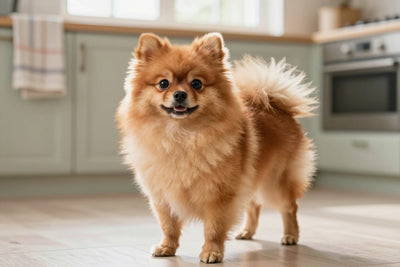
A fluffy orange Pomeranian sitting in a bright kitchen
Breed Encyclopedia

Pomeranian

The Pomeranian is a tiny, fluffy companion with an outgoing, bright and lively personality wrapped in a big double coat. At just 3 to 7 pounds, a Pom needs truly tiny treats, and the breed club flags knees, teeth and hair loss as things to watch.
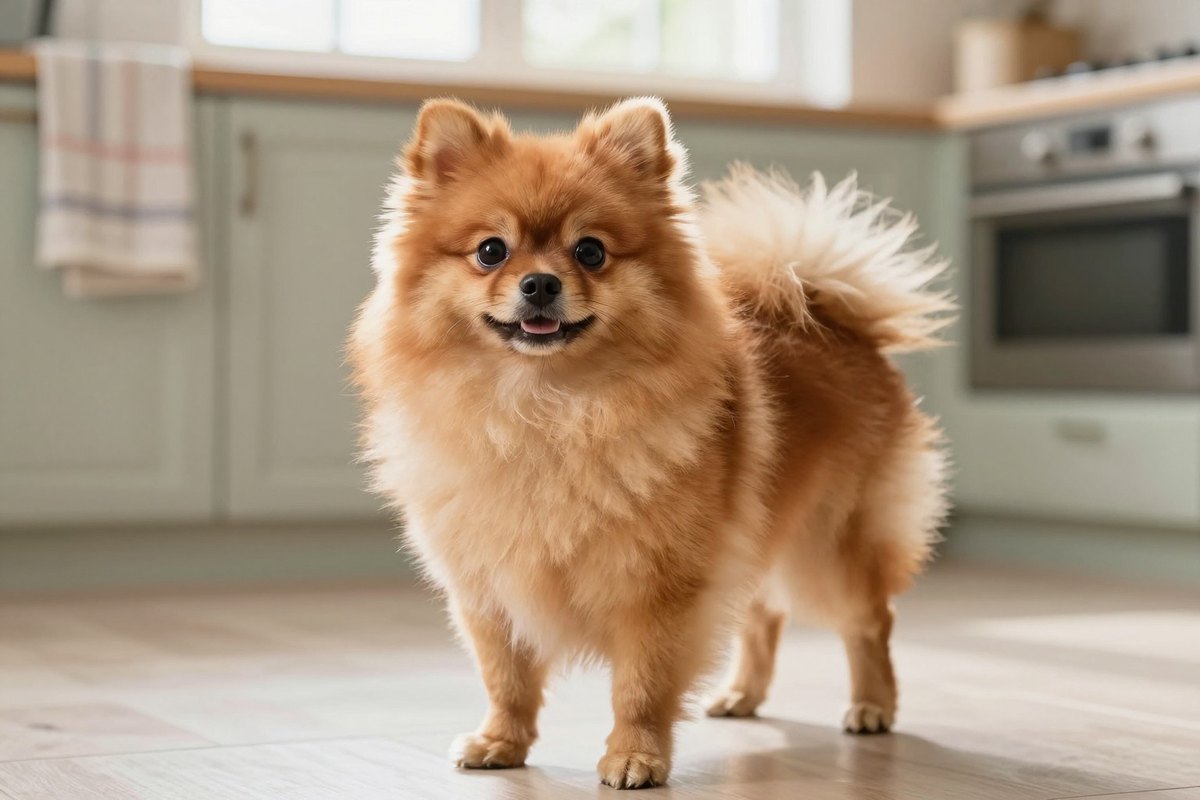
A fluffy orange Pomeranian sitting in a bright kitchen

  • SizeToy
  • AKC groupToy Group
  • Height6-7 in
  • Weight3-7 lb
  • Life expectancy12-16 years
Part A

About the Pomeranian

Origin and purpose

The Pomeranian is a toy breed of Nordic descent that was bred down to toy size and made fashionable in Victorian England, with Queen Victoria given much of the credit. AKC notes that royalty and everyday owners alike have long favored it as a companion. (AKC breed standard, American Pomeranian Club flier, AKC breed page)

Poms are outgoing, bright and lively little dogs. (AKC breed standard, AKC, American Pomeranian Club flier) AKC places the breed in the Toy Group, and it moved up three spots, from No. 22 to No. 19, on AKC's list of the most popular breeds of 2025. (AKC groups, AKC 2025 rankings)

Coat and energy

The Pom wears a profuse double coat: a short, dense undercoat with long, harsh-textured guard hairs growing through it. All colors and patterns are allowed, and brushing a couple of times a week helps prevent mats. (AKC breed standard, AKC, American Pomeranian Club flier)

AKC calls the Pom an active breed that enjoys short walks, runs and outdoor play. Because the dog is so small, those needs are easy to meet. (AKC)

Nutrition and weight

The AKC standard calls for 3 to 7 lb, with 4 to 6 lb ideal for show dogs, and sets no height; AKC's breed article says Poms stand 6 to 7 inches tall. AKC lists a life expectancy of 12-16 years. (AKC breed page) (AKC breed standard, AKC, AKC lifespan article)

At that size, a single human-sized cookie can be a big share of a Pom's daily calories, so keep all treats under 10% of the day's calories, as Merck advises. Merck also notes that small-breed puppies may need to eat more than three times a day, and treats should never replace a puppy's regular meals. (Merck: feeding)

The American Pomeranian Club warns that a Pom's small stomach is not suited to being a "garbage disposal" and advises against feeding spicy junk food as tidbits. (American Pomeranian Club flier)

Health watch

  • Kneecap dislocation (patellar luxation): The kneecap slips out of its groove. Merck lists the Pomeranian among breeds with an inherited tendency for it to slip toward the inside of the leg (medial patellar luxation), and the breed club says Poms can be prone to trouble with the knees of their hind legs. No specific treat link, though keeping a toy dog lean, with treat calories counted, is sensible general practice. (Merck: inherited joint conditions, American Pomeranian Club flier, Merck: feeding)
  • Tartar build-up and dental problems: The breed club says Poms' teeth tend to build up a lot of tartar, which calls for regular dental care. Count a homemade biscuit as a calorie extra, not as tooth care, and ask your veterinarian about a dental-care routine. (American Pomeranian Club flier)
  • Hair loss (alopecia): The breed club notes that Poms can develop abnormal hair loss with no known cause. No specific treat link. (American Pomeranian Club flier)

Fun fact

Pomeranians weren't always lap-sized. The breed club says the original Nordic dogs weighed 20 to 30 pounds, and Queen Victoria is credited with helping shrink the breed toward today's 3 to 7 pound toy and making it popular. (American Pomeranian Club flier)

Part B

Baking, treats and ingredients

Breed-specific baking notes

  • Think crumbs, not cookies. For a 3-7 lb dog, a treat should be a fingernail-sized bite or smaller, and only a few a day, so all treats stay under 10% of daily calories. (AKC breed standard, Merck: feeding)
  • Keep recipes plain. Follow the breed club's advice to skip rich or spicy "junk food" tidbits: a Pom's small stomach doesn't handle table scraps well, so simple, plain recipes are the better choice. (American Pomeranian Club flier)
  • A treat is not tooth care. Don't count on a baked treat to clean teeth. The breed club says Poms build up a lot of tartar, so regular dental care still matters. (American Pomeranian Club flier)

General baking safety (all dogs)

  • Never use xylitol. The FDA warns that xylitol can trigger a sudden insulin release and a drop in blood sugar within 10 to 60 minutes, and that it can turn up in baked goods, some peanut and nut butters, sugar-free gum and sugar-free candy, so read every label. If your dog eats xylitol, contact your veterinarian or an animal poison control line right away. (FDA)
  • Leave these out of every bake. The ASPCA lists chocolate, coffee and other sources of caffeine, grapes and raisins, macadamia and other nuts, onions and garlic, and raw yeast dough as foods to keep away from pets. If your dog eats any of these, contact your veterinarian or an animal poison control line, such as the ASPCA Animal Poison Control Center at (888) 426-4435, right away. (ASPCA)
  • Be honest about vanilla. Under the U.S. standard of identity, vanilla extract must contain at least 35% alcohol by volume, and other extracts may also be made with alcohol, so check the label. The ASPCA lists alcohol among foods pets should not have, so leave alcohol-based extracts, vanilla included, out of dog treats. (21 CFR 169.175, ASPCA)

Daily calories and treat budget

A typical neutered adult at 3-7 lb needs roughly 141-266 kcal a day (RER x 1.6, Merck Veterinary Manual), so treats should stay under about 14-27 kcal a day (the 10% guideline). Intact, very active, young, senior or overweight dogs differ, so ask your veterinarian for your dog's number.

Check an ingredient before you bake, and see how to portion treats with the 10% rule.

Treat size: For a typical neutered adult Pomeranian at 3-7 lb, keep treats under about 14-27 kcal a day, roughly 10% of daily calories.

Ask your veterinarian about

  • Patellar luxation
  • Tartar build-up and dental problems
  • Hair loss (alopecia)

Breed tendencies don't mean your dog has a condition. Your veterinarian knows your dog.

Tiny puppies need regular meals of their complete puppy food. Treats never replace a meal. If your puppy is weak, trembling or unsteady, call your vet straight away.

Ingredients to know

Sources

  1. Official Standard of the Pomeranian, American Kennel Club. Checked October 22, 2026.
  2. An Introduction to the Pomeranian (breed club flier), American Pomeranian Club (AKC parent club), flier hosted by AKC. Checked October 22, 2026.
  3. Pomeranian Dog Breed Information, American Kennel Club. Checked October 22, 2026.
  4. Is the Pomeranian the Right Breed for Your Lifestyle?, American Kennel Club. Checked October 22, 2026.
  5. List of Breeds by Group, American Kennel Club. Checked October 22, 2026.
  6. Most Popular Dog Breeds of 2025, American Kennel Club. Checked October 22, 2026.
  7. How Long Do Dogs Live?, American Kennel Club. Checked October 22, 2026.
  8. Feeding Practices in Small Animals, Merck Veterinary Manual. Checked October 22, 2026.
  9. Table: Heritable Conformational Conditions Resulting in Canine Osteoarthritis, Merck Veterinary Manual. Checked October 22, 2026.
  10. Paws Off Xylitol; It's Dangerous for Dogs, U.S. Food and Drug Administration. Checked October 22, 2026.
  11. People Foods to Avoid Feeding Your Pets, ASPCA Animal Poison Control Center. Checked October 22, 2026.
  12. 21 CFR 169.175 -- Vanilla extract., U.S. Food and Drug Administration regulation, published in the Electronic Code of Federal Regulations (eCFR). Checked October 22, 2026.

Last checked against these sources: October 22, 2026.

Written by VanillaGoods from the cited sources. Not reviewed by a veterinarian. Not a substitute for veterinary advice.