
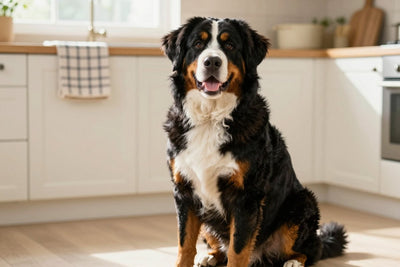
A tricolor Bernese Mountain Dog sitting in a bright kitchen
Breed Encyclopedia

Bernese Mountain Dog

The Bernese Mountain Dog is a big, sturdy, tricolored Swiss farm dog with a sweet, affectionate and good-natured temperament. Berners shed a lot and sadly have short lives, so slow, steady puppy growth, a lean adult weight and modest treat portions all matter in the kitchen.
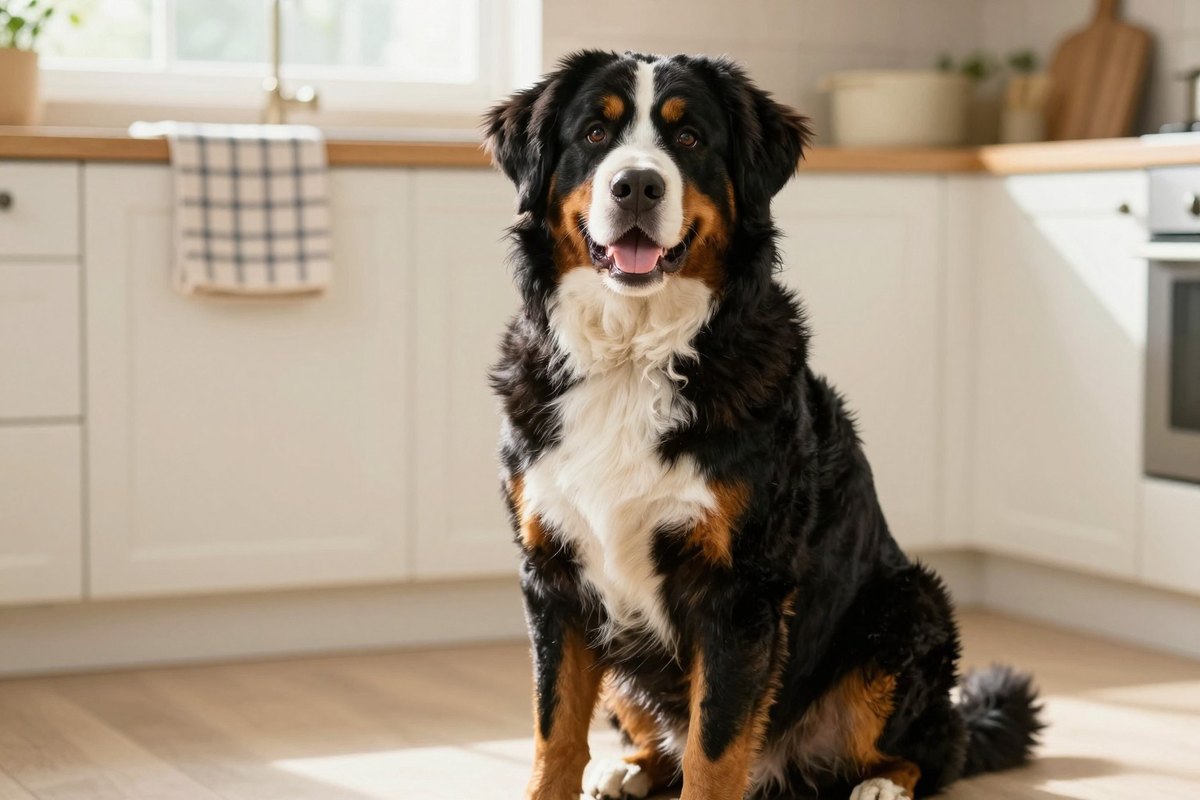
A tricolor Bernese Mountain Dog sitting in a bright kitchen

  • SizeGiant
  • AKC groupWorking Group
  • HeightMales 25-27.5 in, females 23-26 in
  • WeightMales 80-115 lb, females 70-95 lb
  • Life expectancy7-10 years
Part A

About the Bernese Mountain Dog

Origin and purpose

The Bernese Mountain Dog comes from Switzerland, where it was bred as a general-purpose farm dog and watchdog. (BMDCA flier) Today it is known for a sweet, affectionate and good-natured temperament in a big, sturdy, tricolored body. (AKC breed page, AKC breed standard) AKC places the breed in the Working Group, and it ranked No. 20 on AKC's list of the most popular breeds of 2025. (AKC groups, AKC 2025 rankings)

Coat and energy

The thick, moderately long double coat is straight or slightly wavy with a natural shine, in a tricolor of jet black, rich rust and clear white. It sheds considerably, and weekly brushing helps. (AKC breed standard, AKC, BMDCA flier)

AKC says Berners enjoy daily exercise such as walks and hikes but are not as intense as many herding or sporting breeds. The breed club recommends at least 30 minutes of moderately active exercise a day for adults and says exercise should never be forced on puppies. (AKC, BMDCA flier)

Nutrition and weight

The AKC standard sets height (males 25-27.5 inches, females 23-26 inches at the withers) but no weight. AKC gives 80-115 lb for males and 70-95 lb for females (AKC breed page), and the breed club gives 90-120 lb for males and 75-105 lb for females in properly structured adults, adding that overweight should be avoided. (AKC breed standard, AKC, AKC weight chart, BMDCA flier)

The club favors slow, steady growth for Berner puppies. Merck likewise prefers slow growth and says puppies expected to weigh 32 kg (about 70 lb) or more as adults should eat a complete growth diet labeled for large-size dogs. It adds that putting extra calcium, phosphorus or vitamin D into a complete and balanced growth diet is rarely necessary and may be harmful. (BMDCA flier, Merck: feeding)

Adult Berners are usually fed twice a day to lower the chance of bloat, and the club says they should not be allowed to get overweight. (BMDCA flier)

Health watch

Berners have short lives. AKC gives a life expectancy of 7-10 years, and the breed club puts the average at slightly more than seven years, with some dogs living to ten and beyond. The club's health page calls a 7-8 year life span too short for a large breed. (AKC, AKC lifespan article, BMDCA flier, BMDCA health)

  • Histiocytic sarcoma (a cancer): The breed club lists cancer among the breed's health issues and offers a histiocytic sarcoma risk test. No specific treat link. (BMDCA health, BMDCA flier)
  • Elbow and hip dysplasia: Abnormal development of the elbow or hip joint that leads to lameness and arthritis. Merck lists the Bernese Mountain Dog for two inherited forms of elbow dysplasia (fragmented coronoid process and ununited anconeal process) and for shoulder osteochondritis dissecans, and the breed club lists hip and elbow dysplasia among the breed's health concerns. The club favors slow, steady puppy growth and says Berners should not get overweight, so keep puppy treats small and adult dogs lean. (Merck: inherited joint conditions, BMDCA flier, Merck: feeding)
  • Bloat (gastric dilatation-volvulus): The stomach swells with gas (gastric dilatation) and can then twist (volvulus), and the breed club lists bloat among the breed's health problems. The club says adult Berners are usually fed twice a day to lower the chance of bloat, and the ASPCA warns that raw yeast dough can also cause painful stomach bloating, so never let a dog eat unbaked bread dough. (BMDCA flier, ASPCA)

Fun fact

Berners were true farm all-rounders: they pulled carts to market, drove dairy cattle and kept watch over the farm. Their German name, Berner Sennenhund, points to their home, the Canton of Bern. (BMDCA flier)

Part B

Baking, treats and ingredients

Breed-specific baking notes

  • Go small for puppies. Keep homemade treats small and occasional for Berner puppies so they don't add extra growth-boosting calories or unbalance a large-breed growth diet, and skip calcium-rich add-ons unless a veterinarian recommends them. (BMDCA flier, Merck: feeding)
  • Aim for a lean adult. A big dog gets a bigger treat allowance in absolute terms, but the under-10% rule still applies. Merck and the breed club both flag joint problems in this breed, and the club warns against overweight, so a lean Berner is the goal. (Merck: feeding, Merck: inherited joint conditions, BMDCA flier)
  • Guard the rising dough. Keep raw yeast dough well out of reach while you bake: the ASPCA warns that rising dough can cause painful bloating, and bloat is already on the Berner club's list of breed concerns. (ASPCA, BMDCA flier)

General baking safety (all dogs)

  • Never use xylitol. The FDA warns that xylitol can trigger a sudden insulin release and a drop in blood sugar within 10 to 60 minutes, and that it can turn up in baked goods, some peanut and nut butters, sugar-free gum and sugar-free candy, so read every label. If your dog eats xylitol, contact your veterinarian or an animal poison control line right away. (FDA)
  • Leave these out of every bake. The ASPCA lists chocolate, coffee and other sources of caffeine, grapes and raisins, macadamia and other nuts, onions and garlic, and raw yeast dough as foods to keep away from pets. If your dog eats any of these, contact your veterinarian or an animal poison control line, such as the ASPCA Animal Poison Control Center at (888) 426-4435, right away. (ASPCA)
  • Be honest about vanilla. Under the U.S. standard of identity, vanilla extract must contain at least 35% alcohol by volume, and other extracts may also be made with alcohol, so check the label. The ASPCA lists alcohol among foods pets should not have, so leave alcohol-based extracts, vanilla included, out of dog treats. (21 CFR 169.175, ASPCA)

Daily calories and treat budget

A typical neutered adult at 70-115 lb needs roughly 1,498-2,174 kcal a day (RER x 1.6, Merck Veterinary Manual), so treats should stay under about 150-217 kcal a day (the 10% guideline). Intact, very active, young, senior or overweight dogs differ, so ask your veterinarian for your dog's number.

Check an ingredient before you bake, and see how to portion treats with the 10% rule.

Treat size: For a typical neutered adult Berner at 70-115 lb, keep treats under about 150-217 kcal a day, roughly 10% of daily calories.

Ask your veterinarian about

  • Histiocytic sarcoma
  • Elbow dysplasia
  • Hip dysplasia
  • Bloat (GDV)

Breed tendencies don't mean your dog has a condition. Your veterinarian knows your dog.

Ingredients to know

Sources

  1. Congratulations on your new Berner puppy! (breed club flier, 2014), Bernese Mountain Dog Club of America (AKC parent club), flier hosted by AKC. Checked October 22, 2026.
  2. Bernese Mountain Dog - Dog Breed Information, American Kennel Club. Checked October 22, 2026.
  3. Official Standard of the Bernese Mountain Dog, American Kennel Club. Checked October 22, 2026.
  4. List of Breeds by Group, American Kennel Club. Checked October 22, 2026.
  5. Most Popular Dog Breeds of 2025, American Kennel Club. Checked October 22, 2026.
  6. Is the Bernese Mountain Dog a Good Fit for You?, American Kennel Club. Checked October 22, 2026.
  7. Breed Weight Chart, American Kennel Club. Checked October 22, 2026.
  8. Feeding Practices in Small Animals, Merck Veterinary Manual. Checked October 22, 2026.
  9. How Long Do Dogs Live?, American Kennel Club. Checked October 22, 2026.
  10. Health, Bernese Mountain Dog Club of America (AKC parent club). Checked October 22, 2026.
  11. Table: Heritable Conformational Conditions Resulting in Canine Osteoarthritis, Merck Veterinary Manual. Checked October 22, 2026.
  12. People Foods to Avoid Feeding Your Pets, ASPCA Animal Poison Control Center. Checked October 22, 2026.
  13. Paws Off Xylitol; It's Dangerous for Dogs, U.S. Food and Drug Administration. Checked October 22, 2026.
  14. 21 CFR 169.175 -- Vanilla extract., U.S. Food and Drug Administration regulation, published in the Electronic Code of Federal Regulations (eCFR). Checked October 22, 2026.

Last checked against these sources: October 22, 2026.

Written by VanillaGoods from the cited sources. Not reviewed by a veterinarian. Not a substitute for veterinary advice.