
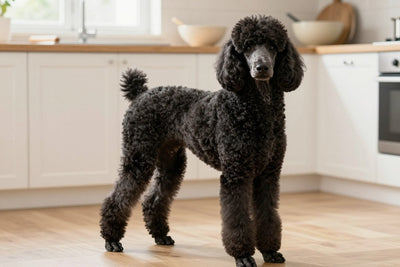
A curly apricot Standard Poodle sitting upright in a bright kitchen
Breed Encyclopedia

Poodle

Athletic and famously curly, the Poodle began as a German duck-retrieving water dog and now comes in Standard, Miniature and Toy sizes. All three are active dogs that need daily exercise, mental stimulation and regular grooming, and their treats should be sized to match the dog.

A curly apricot Standard Poodle sitting upright in a bright kitchen

  • SizeVaries
  • AKC groupNon-Sporting Group (Standard and Miniature); Toy Group (Toy)
  • HeightStandard over 15 in; Miniature 10-15 in; Toy no more than 10 in
  • WeightStandard: males 60-70 lb, females 40-50 lb; Miniature 10-15 lb; Toy 4-6 lb
  • Life expectancy10-18 years
Part A

About the Poodle

Origin and purpose

The Poodle most likely comes from Germany, with strong later ties to France. It was bred as a water retriever that fetched ducks and other waterfowl, and the smaller Miniature and Toy sizes were later bred down to suit city dwellers. (AKC breed history)

AKC shows Standard and Miniature Poodles in the Non-Sporting Group and Toy Poodles in the Toy Group, and the breed ranked No. 6 in AKC's 2025 popularity rankings. (AKC breed guide; AKC Toy Group standards; AKC 2025 rankings)

Coat and energy

The dense, curly coat has a naturally harsh texture (or can be corded). It sheds very little but needs frequent brushing and regular clipping to prevent mats. (AKC breed standard; AKC breed guide)

Energy is high in all three sizes, so plan on daily exercise and plenty of mental stimulation. (AKC breed guide)

Nutrition and weight

The standard defines the three varieties by shoulder height: Standards are over 15 inches (the breed club says commonly 21-27 inches), Miniatures over 10 and up to 15 inches, and Toys 10 inches or under. AKC gives Standard males 60-70 lb and females 40-50 lb, Miniatures 10-15 lb and Toys 4-6 lb. (AKC breed page) (AKC breed standard; Poodle Club of America; AKC breed guide; AKC weight chart)

With adults running from about 4 lb to 70 lb, serving sizes and treat allowances should match the dog in front of you, not "a Poodle." (AKC breed guide; Merck (feeding))

Merck notes that small-breed puppies may need to be fed more than three times a day, which applies to Toy and Miniature Poodle puppies. (Merck (feeding))

For Standard Poodles, Merck lists once-daily feeding, dry-kibble-only diets and fast eating as bloat risk factors, and suggests several small meals instead of one large meal for high-risk breeds. (Merck (bloat))

Health watch

AKC gives a life expectancy of 10-18 years across all three sizes. (AKC breed page) (AKC breed guide)

  • Bloat, or gastric dilatation-volvulus (Standard Poodles): a life-threatening emergency in which the stomach swells with gas and can twist. Merck lists Standard Poodles among at-risk breeds, and the breed club notes higher risk in Standards. Meal patterns matter: Merck lists once-daily feeding and fast eating as risk factors and recommends restricting exercise around meals, so avoid big treat sessions right before or after vigorous play. (Merck (bloat); Poodle Club of America)
  • Addison's disease (hypoadrenocorticism), Standard Poodles: the adrenal glands stop making enough of some key hormones, causing vague, on-and-off illness that can turn into a sudden crisis. Merck lists Standard Poodles among overrepresented breeds. No specific treat link is known. (Merck (Addison's disease); Poodle Club of America)
  • Periodontal (dental) disease, Toy Poodles: infection and loss of the tissues that hold teeth in place, caused by plaque buildup. In UK primary-care records, Toy Poodles had about four times the risk of crossbred dogs. No specific treat link is known. (RVC VetCompass)
  • Kneecap dislocation and Legg-Calve-Perthes disease (Toy and Miniature Poodles): the kneecap slips out of its groove (patellar luxation), or the top of the thighbone loses its blood supply and collapses (Legg-Calve-Perthes, usually seen at 4-12 months). The breed club says both are more likely in Toys and Miniatures. No specific treat link is known. (Poodle Club of America; Merck (patellar luxation); OFA)
  • Pancreatitis: inflammation of the pancreas. Merck lists Poodles among breeds with a reported higher rate. Merck says dietary indiscretion (eating outside the normal diet) is believed to be a common risk factor in dogs, so rich, buttery pastry and table scraps are a poor fit. (Merck (pancreatitis))

Fun fact

The name likely comes from the German "pudeln," meaning to splash in water. The fancy show clip began as a working cut: hunters shaved the legs, neck and tail so the dogs could swim more easily and left hair over the chest and joints for warmth. (AKC breed history)

Part B

Baking, treats and ingredients

Breed-specific baking notes

  • Size the bite to the variety. A 4-6 lb Toy Poodle needs crumb-sized pieces and very few of them, while a Standard can take a larger biscuit. The treat allowance shrinks with the dog. (AKC breed guide; Merck (feeding))
  • For Standard Poodles, offer treats in small amounts spread out, not as a big pile, and not right around hard exercise, in line with Merck's bloat-prevention guidance for high-risk breeds. (Merck (bloat))
  • Keep butter-rich pastry and scraps off the menu: Merck lists Poodles among breeds with a reported higher rate of pancreatitis. (Merck (pancreatitis))

General baking notes for all dogs

  • Treats of any kind, homemade pastry included, should add up to less than 10% of a dog's daily calories, because treats are not complete and balanced food. (Merck (feeding))
  • Sugar-free baking is a real hazard for every dog. The FDA says xylitol can cause a fast, dangerous drop in a dog's blood sugar, and it lists baked goods, sugar-free desserts, sugar-free gum and candy, and some nut butters as products that may contain it. Check every label before you bake, and if a dog eats something with xylitol, contact your veterinarian or an animal poison control line right away. (FDA)

Daily calories and treat budget

For Poodles the range spans the Toy to Standard varieties: a typical neutered adult at 4-70 lb needs roughly 175-1,498 kcal a day (RER x 1.6, Merck Veterinary Manual), so treats should stay under about 18-150 kcal a day (the 10% guideline). A Toy sits at the low end of that range and a Standard at the high end. Intact, very active, young, senior or overweight dogs differ, so ask your veterinarian for your dog's number.

Check an ingredient before you bake, and see our guide to treat portions and the 10% guideline.

Treat size: Treat budgets span the varieties, from about 18 kcal a day for a 4 lb Toy to about 150 kcal a day for a 70 lb Standard (10% of a typical neutered adult's daily calories).

Ask your veterinarian about

  • Bloat (GDV), Standard Poodles
  • Addison's disease, Standard Poodles
  • Periodontal disease, Toy Poodles
  • Patellar luxation and Legg-Calve-Perthes disease, Toy and Miniature Poodles
  • Pancreatitis

Breed tendencies don't mean your dog has a condition. Your veterinarian knows your dog.

Ingredients to know

Sources

  1. Poodle History: From Water Retriever to Versatile Companion, American Kennel Club. Checked October 22, 2026.
  2. Is the Poodle a Good Fit for You?, American Kennel Club. Checked October 22, 2026.
  3. Toy Group Breed Standards (April 30, 2026), American Kennel Club. Checked October 22, 2026.
  4. Most Popular Dog Breeds of 2025, American Kennel Club. Checked October 22, 2026.
  5. Official Standard of the Poodle, American Kennel Club. Checked October 22, 2026.
  6. Poodle Club of America new puppy guide (Congratulates you on your new Poodle Puppy!), Poodle Club of America (AKC parent breed club). Checked October 22, 2026.
  7. Breed Weight Chart, American Kennel Club. Checked October 22, 2026.
  8. Feeding Practices in Small Animals, Merck Veterinary Manual. Checked October 22, 2026.
  9. Gastric Dilation and Volvulus in Small Animals, Merck Veterinary Manual. Checked October 22, 2026.
  10. Addison Disease (Hypoadrenocorticism) in Animals, Merck Veterinary Manual. Checked October 22, 2026.
  11. Epidemiology of periodontal disease in dogs in the UK primary-care veterinary setting (RVC news release), Royal Veterinary College VetCompass (reporting O'Neill et al. 2021, J Small Anim Pract, doi:10.1111/jsap.13405). Checked October 22, 2026.
  12. Patellar Luxation in Dogs and Cats, Merck Veterinary Manual. Checked October 22, 2026.
  13. Legg-Calve-Perthes, Orthopedic Foundation for Animals. Checked October 22, 2026.
  14. Pancreatitis in Dogs and Cats, Merck Veterinary Manual. Checked October 22, 2026.
  15. Paws Off Xylitol; It's Dangerous for Dogs, U.S. Food and Drug Administration. Checked October 22, 2026.
  16. Breed page (height, weight, life expectancy), American Kennel Club. Checked October 22, 2026.

Last checked against these sources: October 22, 2026.

Written by VanillaGoods from the cited sources. Not reviewed by a veterinarian. Not a substitute for veterinary advice.