
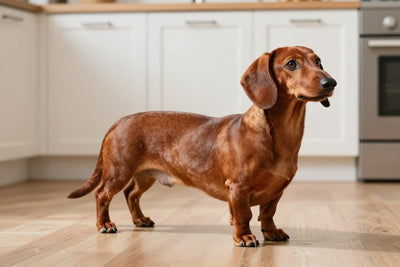
A smooth red Dachshund sitting on the floor of a bright kitchen
Breed Encyclopedia

Dachshund

The long, low "badger dog" from Germany comes in standard and miniature sizes and in smooth, wirehaired and longhaired coats, and it is bolder and more active than those short legs suggest. Its breed club urges owners to keep Dachshunds trim, so tiny, counted treats are the way to go.

A smooth red Dachshund sitting on the floor of a bright kitchen

  • SizeSmall
  • AKC groupHound Group
  • HeightStandard 8-9 in; miniature 5-6 in
  • WeightStandard 16-32 lb; miniature 11 lb and under
  • Life expectancy12-16 years
Part A

About the Dachshund

Origin and purpose

Dachshunds come from Germany, where the type took shape in the late 1600s. German foresters and hunters bred them to go underground after badgers (the name means "badger dog"), and miniatures were developed in the 1800s for rabbits. (AKC breed history; Dachshund Club of America)

AKC places the Dachshund in the Hound Group, and it ranked No. 5 in AKC's 2025 popularity rankings. (AKC breed guide; AKC 2025 rankings)

Coat and energy

There are three coat types: smooth, wirehaired and longhaired. The longhaired and wirehaired coats need more grooming than the smooth. (AKC breed standard; AKC breed guide)

AKC rates the breed's energy as moderate. (AKC breed guide)

Nutrition and weight

The AKC standard sizes Dachshunds by weight, not height. Standards usually weigh 16-32 lb, and miniatures weigh 11 lb or under at 12 months and older. AKC gives no separate male and female weights. (AKC weight chart; AKC breed standard; Dachshund Club of America)

The Dachshund Club of America warns that the feeding amounts on dog food labels can be more than a fit Dachshund needs, and it advises against overfeeding and too many treats. The club links extra weight to joint problems, lower stamina, diabetes and possibly back problems. (Dachshund Club of America)

In a large UK owner survey, Dachshunds exercised for less than 30 minutes a day had higher odds of disc disease. (DachsLife 2015 study)

Miniatures weigh 11 lb or less, so their daily treat allowance is very small. (AKC breed standard; Merck (feeding))

Health watch

AKC gives a typical life expectancy of 12-16 years. (AKC breed page) (AKC breed facts)

  • Intervertebral disc disease (IVDD): the cushioning discs between the vertebrae wear out early in short-legged breeds and can bulge or burst into the spinal canal, causing back pain, weakness or paralysis. Merck names the Dachshund among these breeds and puts lifetime prevalence in Miniature Dachshunds at about 20%. The breed club says extra weight may add to back problems, so keep treats small and counted, though evidence that body weight itself drives disc disease in Dachshunds is mixed. (Merck (spinal disease); DachsLife 2015 study; Dachshund Club of America)
  • Pancreatitis: inflammation of the pancreas, the organ that makes digestive enzymes. Merck lists Dachshunds among breeds with a reported higher rate. Merck says eating things outside the normal diet (dietary indiscretion) is believed to be a common risk factor in dogs, so rich, buttery pastry and table scraps are a poor fit. (Merck (pancreatitis))
  • Lafora disease (Miniature Wirehaired Dachshunds): an inherited, slowly worsening form of epilepsy that causes sudden muscle jerks and later seizures, starting on average around age 7. It is caused by a gene change that a DNA test can detect. No specific treat link is known. (Ahonen et al. 2018)

Fun fact

The first official Olympic mascot was a striped Dachshund named Waldi, created for the 1972 Munich Games, and that year's marathon route was laid out in a Dachshund shape. (AKC breed facts)

Part B

Baking, treats and ingredients

Breed-specific baking notes

  • Bake tiny, pre-portioned bites and count them toward the day's food. The Dachshund breed club specifically warns about too many treats and links extra weight to back trouble. (Dachshund Club of America)
  • Skip butter-heavy pastry and scraps. Merck lists Dachshunds among breeds with a reported higher rate of pancreatitis and names dietary indiscretion as a likely common trigger in dogs. (Merck (pancreatitis))

General baking notes for all dogs

  • Treats of any kind, homemade pastry included, should add up to less than 10% of a dog's daily calories, because treats are not complete and balanced food. For a miniature Dachshund, that leaves room for only a few small bites a day. (Merck (feeding))
  • Sugar-free baking is a real hazard for every dog. The FDA says xylitol can cause a fast, dangerous drop in a dog's blood sugar, and it lists baked goods, sugar-free desserts, sugar-free gum and candy, and some nut butters as products that may contain it. Check every label before you bake, and if a dog eats something with xylitol, contact your veterinarian or an animal poison control line right away. (FDA)

Daily calories and treat budget

A typical neutered adult at 11-32 lb needs roughly 374-833 kcal a day (RER x 1.6, Merck Veterinary Manual), so treats should stay under about 37-83 kcal a day (the 10% guideline). Intact, very active, young, senior or overweight dogs differ, so ask your veterinarian for your dog's number.

Check an ingredient before you bake, and see our guide to treat portions and the 10% guideline.

Treat size: A typical neutered adult Dachshund at 11-32 lb should get no more than about 37-83 kcal a day from treats (10% of roughly 374-833 kcal), with miniatures at the low end.

Ask your veterinarian about

  • Intervertebral disc disease (IVDD)
  • Pancreatitis
  • Lafora disease (Miniature Wirehaired)

Breed tendencies don't mean your dog has a condition. Your veterinarian knows your dog.

Ingredients to know

Sources

  1. Dachshund History: The Badger Dog's Fascinating Past, American Kennel Club. Checked October 22, 2026.
  2. An Introduction to the Dachshund, Dachshund Club of America (AKC parent breed club). Checked October 22, 2026.
  3. Is the Dachshund a Good Fit For You?, American Kennel Club. Checked October 22, 2026.
  4. Most Popular Dog Breeds of 2025, American Kennel Club. Checked October 22, 2026.
  5. Official Standard of the Dachshund, American Kennel Club. Checked October 22, 2026.
  6. Breed Weight Chart, American Kennel Club. Checked October 22, 2026.
  7. DachsLife 2015: an investigation of lifestyle associations with the risk of intervertebral disc disease in Dachshunds (2016; doi:10.1186/s40575-016-0039-8), Canine Genetics and Epidemiology (Packer RMA, Seath IJ, O'Neill DG, De Decker S, Volk HA). Checked October 22, 2026.
  8. Feeding Practices in Small Animals, Merck Veterinary Manual. Checked October 22, 2026.
  9. Dachshund Facts You May Not Know, American Kennel Club. Checked October 22, 2026.
  10. Degenerative Diseases of the Spinal Column and Cord in Animals, Merck Veterinary Manual. Checked October 22, 2026.
  11. Pancreatitis in Dogs and Cats, Merck Veterinary Manual. Checked October 22, 2026.
  12. Nationwide genetic testing towards eliminating Lafora disease from Miniature Wirehaired Dachshunds in the United Kingdom (2018; doi:10.1186/s40575-018-0058-8), Canine Genetics and Epidemiology (Ahonen S, Seath I, Rusbridge C, et al.). Checked October 22, 2026.
  13. Paws Off Xylitol; It's Dangerous for Dogs, U.S. Food and Drug Administration. Checked October 22, 2026.
  14. DachsLife 2015: an investigation of lifestyle associations with the risk of intervertebral disc disease in Dachshunds, Canine Genetics and Epidemiology. Checked October 22, 2026.
  15. Breed page (height, weight, life expectancy), American Kennel Club. Checked October 22, 2026.

Last checked against these sources: October 22, 2026.

Written by VanillaGoods from the cited sources. Not reviewed by a veterinarian. Not a substitute for veterinary advice.